
To get rid of an old hot tub, have an electrician disconnect its circuit, let the water dechlorinate and drain it on your own property, take leftover spa chemicals to a household hazardous waste drop-off, then cut the tub into sections, recycle the metal and haul the rest to a licensed landfill.
That is five jobs, and each one has its own rule. The electrical work follows the National Electrical Code. The water falls under stormwater rules. The chemicals are household hazardous waste. The metal has a recycling market and the rest does not. This guide walks through each step in the order it has to happen, with the rules that apply to homes in West Chester Township and the rest of Butler County.
The five steps at a glance
- Kill the power at the breaker, then have the spa circuit terminated by a qualified electrician.
- Stop sanitizing and hold the water so the chlorine or bromine can fade, then drain it onto your own lawn, away from storm drains.
- Collect the chemicals (chlorine, bromine, pH adjusters, shock) for a household hazardous waste drop-off.
- Take the tub apart: cover, cabinet panels, equipment, then the shell in sections.
- Sort and haul: metal to a scrap recycler, everything else to a licensed disposal facility.
Most of the work is in steps 4 and 5, but steps 1 to 3 are where homeowners get into trouble. Anyone planning to hand the whole job to a hot tub removal crew should still know who is responsible for each one.
Step 1: Disconnect the power the right way
A hot tub runs on a dedicated circuit, and the National Electrical Code (NFPA 70, Article 680) sets the rules for wiring around pools, spas and hot tubs, including the ground fault protection and the maintenance disconnect beside the tub. Removing the tub leaves that circuit live unless someone terminates it.
The U.S. Consumer Product Safety Commission and the American Red Cross have warned that faulty and aging wiring around pools and spas causes electrocutions, and their advice is to have “an electrician who is qualified in pool and spa repairs” inspect and work on the equipment. In practice that means three things:
- Switch off the spa breaker in the main panel and the disconnect box near the tub, and confirm the control panel is dark.
- Have the electrician remove or safely terminate the conductors at the panel and the disconnect, so no live wire is left in the yard once the tub is gone.
- Ask the electrician whether a permit is required for the work at your address. Permit rules are set locally and can differ between a township and a city.
A removal crew can unhook the tub from a dead circuit. Terminating the circuit itself is electrical work, so plan it as a separate appointment that happens first.
Step 2: Drain the water without breaking stormwater rules
The water is the heaviest part of a hot tub by far. Using the U.S. Geological Survey figure of 8.329 pounds for a gallon of water at 70°F, a 450 gallon spa holds about 3,750 pounds of water, close to two tons. The capacity is usually printed on the spec label or in the owner’s manual.

Why the storm drain is off limits
Storm drains are built to carry rain to local streams, not to a treatment plant, and the U.S. EPA’s stormwater guidance identifies residential pools as the main source of chemically treated water entering storm sewers. It says that treated water reaching surface waters “harms local water quality and is toxic to wildlife and fish.” The EPA lists three acceptable routes instead: draining to a sanitary sewer where the local utility allows it, dechlorinating and then discharging, or dechlorinating and using the water for irrigation.
How long to hold the water
Hamilton County Public Health, the health department for the county directly south of Butler County, publishes the clearest regional guidance. It advises shutting off the chlorinator or stopping chemical additions, then holding the water “for at least two days to allow the chlorine to dissipate,” noting that complete dissipation can take up to two weeks. It also asks owners to check that the pH reads between 6.5 and 8.5 with an ordinary pool test kit before releasing the water.
The same advice applies to bromine tubs: stop adding sanitizer, leave the water standing, and test before draining rather than counting days.
Where the water should go
- Run a submersible pump or the tub’s drain spigot to a hose that ends on your own lawn or garden beds, well back from the street, ditch or any storm inlet.
- Move the hose end every so often so the water soaks in instead of running off. Hamilton County Public Health asks that released water stay on the property and not pond long enough to cause odors or mosquito breeding.
- Never send the filter backwash or the last gallons of sludge to a storm drain. Bag the filters and wipe out the footwell.
- Check with your township or city before using a sanitary cleanout. Sewer utilities set their own rules, and some restrict chlorinated water entirely.
Step 3: Clear out the leftover spa chemicals
Hot tub owners usually have half used containers of chlorine or bromine, shock, pH increaser and decreaser, and clarifier. These are not ordinary trash. A CDC report in Morbidity and Mortality Weekly Report estimated 13,508 emergency department visits from pool chemical injuries between 2015 and 2017, and at least 56.3 percent of them happened at a residence. The most common injury was breathing fumes or dust when opening containers. The CDC’s advice is to keep chlorine products away from acids and other chemicals, open one container at a time, and never mix products.
The Butler County Recycling and Solid Waste District lists pool chemicals among the materials accepted at its Household Hazardous Waste Drop-Off. In 2026 the drop-off ran every Thursday from July 9 through October 29, from 2 to 7 p.m., at 3555 Yankee Road in Middletown. It is free for Butler County residents with proof of residency and does not take business materials. The program is seasonal, so outside those months keep the containers sealed, upright, dry and apart from each other until the next season opens, and call the district at 513-887-3653 to confirm current dates.
The City of Mason’s trash page carries the same reminder from its hauler: pool chemicals and propane tanks never go in trash or recycling containers.
Step 4: Take the tub apart
An empty acrylic spa is still too wide for most gates and too awkward for a pickup bed, which is why removals almost always involve cutting it into sections. The order matters:
- Cover and steps. The cover has a foam core and is often waterlogged and heavy. It goes out first, along with steps, rails and the cover lifter.
- Cabinet panels. The skirting unscrews or pries off and exposes the equipment bay and the spray foam insulation packed around the plumbing.
- Equipment. Pumps, the blower, heater, ozonator and control pack come out whole. These are the parts with recoverable metal.
- Shell. The acrylic and fiberglass shell is cut into sections with a reciprocating saw. Cutting throws fiberglass dust and foam, so eye protection, gloves, long sleeves and a dust mask are the minimum.
- Base and frame. The wood or composite frame and base pan come out last.
If the tub sits inside a deck, a section of decking or framing may have to come out first, which turns the job into light deck and fence demolition. A concrete pad left behind is a separate decision; some owners keep it as a patio, others have it broken up as part of exterior demolition.
Step 5: Send each part to the right place
A hot tub is a mix of materials, and only some of them have a recycling outlet. Sorting before loading is what keeps recyclable metal out of the landfill.
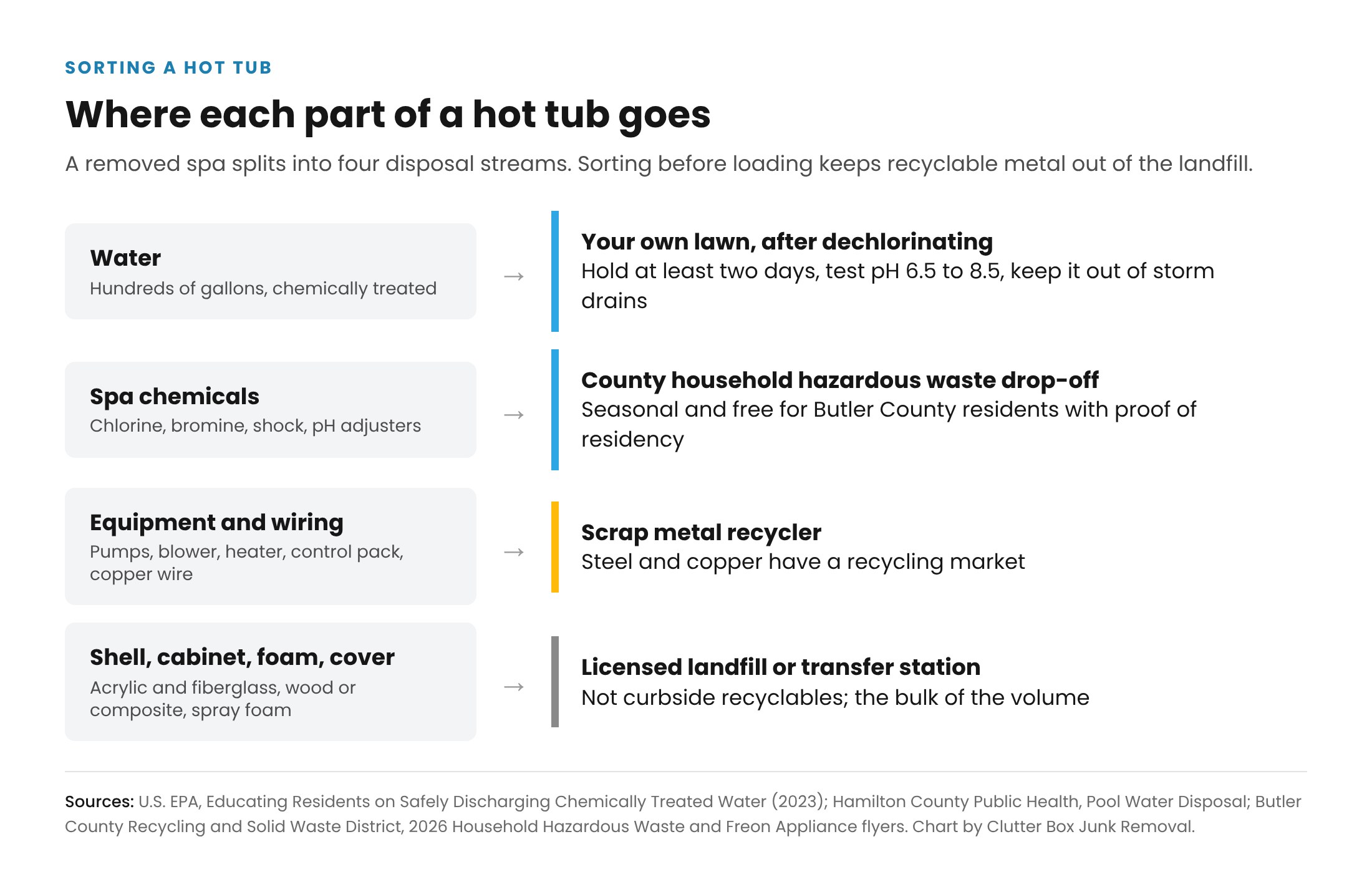
Metal. Pump motors contain copper windings, heaters contain steel and copper elements, and the wiring is copper. The Butler County district directs non-Freon appliances and similar metal items to scrap metal recyclers. Nationally, much of this metal still ends up in landfills: the U.S. EPA’s materials data put the recycling rate for ferrous metals from durable goods at 27.8 percent in 2018. Pulling the equipment out whole makes it easy to keep separate. The scrap metal removal page covers how loose metal is collected.
Shell, cabinet, foam and cover. Acrylic bonded to fiberglass, spray foam and a vinyl cover with a foam core are not curbside recyclables, so these normally go to a licensed landfill or transfer station. That is the bulk of the volume. The article on where junk actually goes explains how loads are sorted between donation, recycling and disposal.
Wood. Cabinet framing and any deck boards removed to free the tub travel with other construction debris.
Why curbside bulk pickup is not built for a hot tub
Every community in the area offers some form of large item collection, but the rules are written for chairs and mattresses. They require notice, and where limits are published they cap the size and weight of each piece and exclude liquids and hazardous materials.
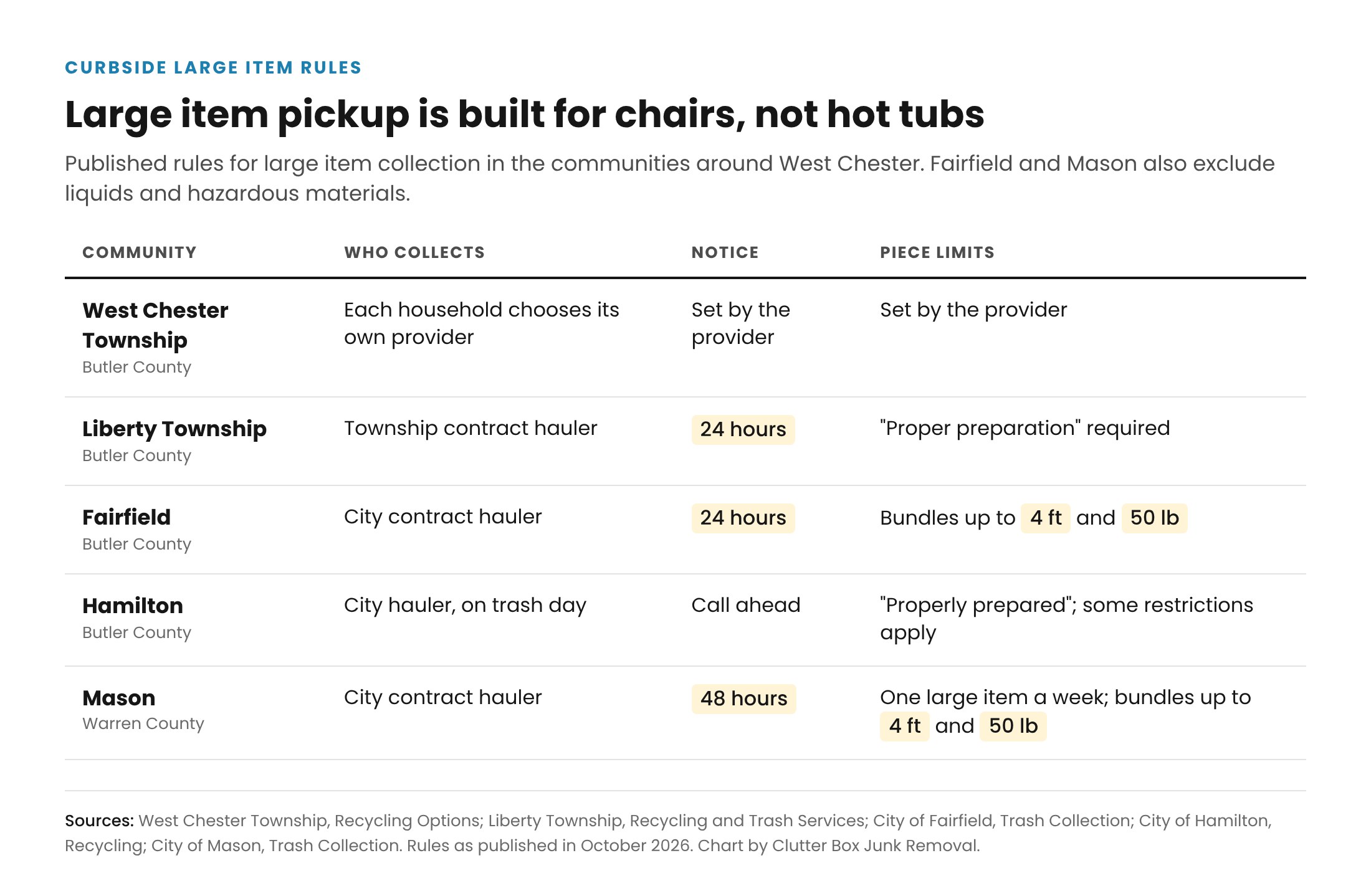
- West Chester Township does not run township-wide trash service. The township’s recycling page says residents “are free to negotiate for their own provider,” so bulk rules depend on that provider’s contract.
- Liberty Township contracts trash and recycling for residents, and its page says bulk pickup “requires 24 hours advance notice and proper preparation.”
- Fairfield asks residents to call the city’s hauler at least 24 hours ahead for large items and limits loose material such as lumber to bundles no longer than 4 feet and no heavier than 50 pounds. Liquids and hazardous materials are not accepted.
- Hamilton offers large item pickup on the normal trash day for residents who call ahead, with items “properly prepared,” and notes that some restrictions apply.
- Mason, across the line in Warren County, allows one large item per week with 48 hours notice and the same 4 foot, 50 pound bundle limit.
Even a compact spa shell is wider than 4 feet, and cutting a full tub into 50 pound pieces would mean dozens of bundles set out over many weeks. For most households that is the point where a single hauled load makes more sense. The guide to getting rid of old furniture covers how the same bulk rules apply to smaller items.
Timing: get it done before the first hard freeze
Late fall is when many owners decide whether a tired hot tub is worth another winter. The calendar argues for deciding early. The National Weather Service office in Wilmington, Ohio, puts the normal first 32°F night of fall on October 25 at both Dayton and the Northern Kentucky airport, the two long-record stations that bracket Butler County. One year in ten, that first freeze arrives by October 12 or 13; nine years in ten, it has arrived by November 5 to 7.
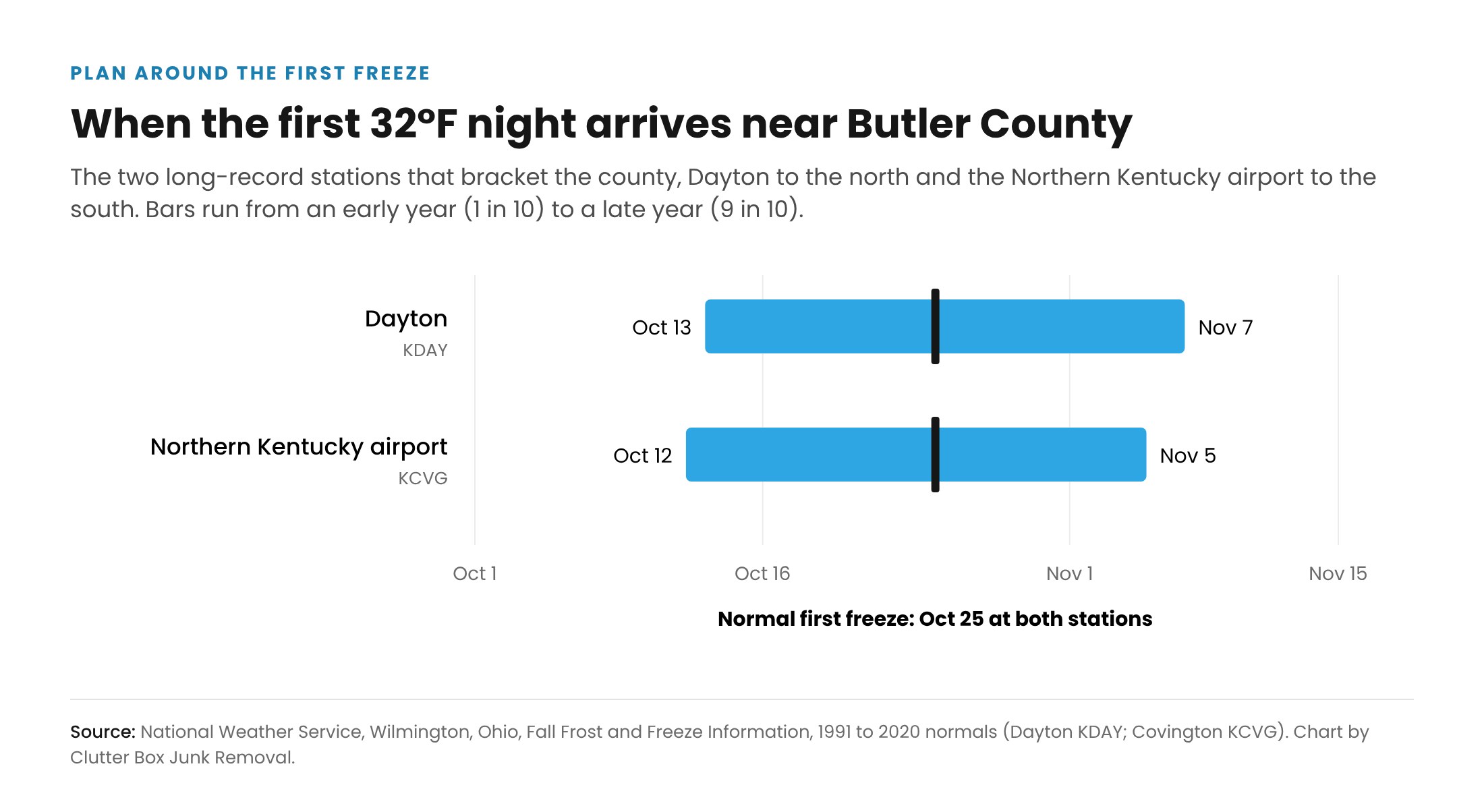
That matters for removal because water expands as it freezes. The USGS notes that ice is about 9 percent less dense than liquid water, so a tub that has been switched off but not fully drained can crack its plumbing and leave a block of ice in the footwell. The water cannot be released until it thaws, and the removal waits until spring. A tub slated for removal is best drained and hauled while nights are still above freezing, or at least drained completely and blown out if the removal date slips.
Getting the site ready for removal day
- Measure the narrowest point on the path out: gate width, side yard clearance, stairs off a deck. That determines how small the sections need to be.
- Confirm the circuit has been terminated and the water drained before the crew arrives.
- Move patio furniture, grills and planters out of the path.
- Decide what happens to the surround, steps, gazebo or privacy screen, and whether the pad stays.
- Expect some lawn damage along the haul path if the ground is soft. Dry weather and frozen ground are both easier than mud.
The checklist on preparing for a junk removal appointment covers the rest of the day-of details.
Other items that usually go in the same load
Hot tub removals tend to happen during a bigger outdoor reset. Old patio sets and outdoor sofas fit with furniture removal. A dead outdoor fridge or a basement dehumidifier falls under refrigerant rules, explained in the guide to disposing of a refrigerator and handled through appliance removal. Spa supplies, pool toys and hoses often come out of the garage at the same time, which is where a garage cleanout fits. When a hot tub is part of selling or settling a property, it usually rolls into a larger estate cleanout.
Common questions
Can a hot tub go out with regular trash?
No. Curbside programs in Butler County limit pieces by size and weight, Fairfield and Mason cap bundles at 4 feet and 50 pounds and exclude liquids and hazardous materials. A whole hot tub, or a shell cut into a few large sections, is outside those rules.
How long should hot tub water sit before draining?
Hamilton County Public Health advises stopping chlorine additions and holding the water at least two days, noting full dissipation can take up to two weeks. Test with a pool kit and confirm the pH is between 6.5 and 8.5 before releasing it onto your own property.
Can hot tub water go down the storm drain?
Not while it is treated. The U.S. EPA describes chemically treated pool and spa water as toxic to fish and wildlife when it reaches surface waters, and storm drains lead straight to creeks. Dechlorinate it and let it soak into the lawn instead.
What do I do with leftover hot tub chemicals?
The Butler County Recycling and Solid Waste District accepts pool chemicals at its seasonal Household Hazardous Waste Drop-Off, free for county residents with proof of residency. Keep containers sealed and apart until the drop-off is open, and never combine products.
Can a hot tub be recycled?
Partly. The pumps, heater, motors and wiring contain steel and copper that scrap metal recyclers take. The acrylic and fiberglass shell, foam insulation and cover are not curbside recyclables and normally go to a licensed landfill.
Do I need an electrician to remove a hot tub?
For the circuit, yes. The National Electrical Code governs spa wiring, and the CPSC recommends an electrician qualified in pool and spa work. The tub itself can be removed once the circuit is dead and terminated.
Hot tub removal in West Chester and Butler County
Clutter Box Junk Removal handles hot tub removal across West Chester, Liberty Township, Fairfield, Hamilton, Mason and the rest of Butler County. Our crew drains the tub, disconnects it from the pad, breaks the shell down where needed, and hauls away the cabinet, cover and surround, with the metal sorted out for recycling. Reseeding the bare ground can be added on. We give a clear price before any work starts, and if a deck section or other structure needs to come out, our demolition services cover that too.
Tell us when you book whether the circuit has already been terminated and what else is going, whether that is a garage full of household junk or a full cleanout. You can see how a pickup works or request a free quote, or call (513) 647-2976.
Sources
- NPDES Stormwater Best Management Practice: Educating Residents on Safely Discharging Chemically Treated Water, U.S. Environmental Protection Agency
- Pool Water Disposal, Hamilton County Public Health
- Pool Chemical Injuries in Public and Residential Settings, United States, 2008 to 2017, and New York, 2018, CDC Morbidity and Mortality Weekly Report
- Don’t Swim With Shocks, U.S. Consumer Product Safety Commission and American Red Cross
- NFPA 70, National Electrical Code, National Fire Protection Association
- Recycling and Solid Waste programs, Butler County Recycling and Solid Waste District
- 2026 Household Hazardous Waste Drop-Off flyer, Butler County Recycling and Solid Waste District
- Ferrous Metals: Material-Specific Data, U.S. Environmental Protection Agency
- Water Density, U.S. Geological Survey Water Science School
- Fall Frost and Freeze Information, National Weather Service, Wilmington, Ohio
- Recycling Options, West Chester Township
- Recycling and Trash Services, Liberty Township
- Trash Collection, City of Fairfield
- Recycling, City of Hamilton
- Trash Collection, City of Mason