
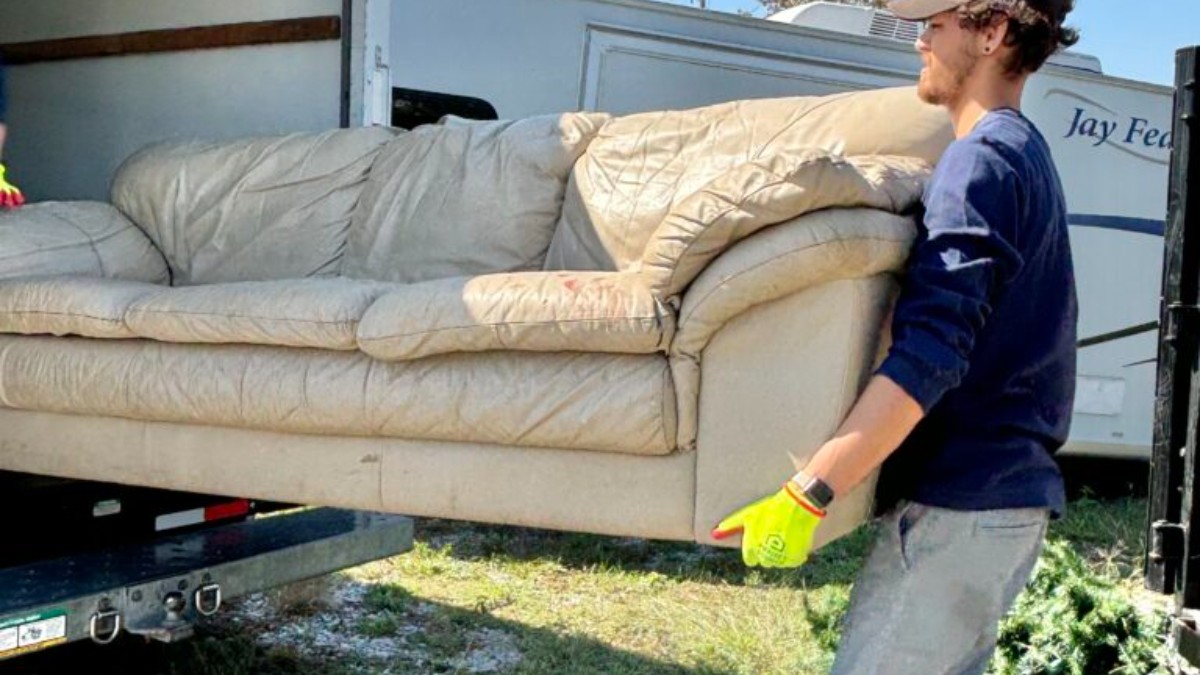
There are six realistic ways to get rid of old furniture: sell it, give it away, donate it, put it out for a bulk curbside pickup, haul it to a disposal site yourself, or hire a removal service. Which one works depends almost entirely on the condition of the piece, because furniture in good condition has several routes and furniture in poor condition has very few.
That last point is the part most guides skip, and it is the reason a sofa can sit in a garage for two years. People assume an unwanted couch has somewhere obvious to go. For a large share of furniture, it does not, and understanding why makes the decision much faster.
Why furniture is genuinely harder to move on than other household items
The U.S. Environmental Protection Agency tracks what happens to durable goods after households finish with them, and the furniture numbers are unlike anything else in the category.
In its most recent product-specific figures, covering 2018, the EPA recorded 12.1 million tons of furniture and furnishings generated in a single year. Of that, 40,000 tons were recycled. Another 2.36 million tons were combusted with energy recovery, and 9.68 million tons went to landfill.
Forty thousand tons out of 12.1 million works out at roughly a third of one percent.
Set that against major appliances in the same EPA dataset: 5.25 million tons generated, 3.14 million tons recycled. That is close to sixty percent.
The difference is not effort or good intentions. It is materials. An old refrigerator is mostly steel, and steel has a buyer at the end of the chain. A sofa is a laminated assembly of kiln-dried wood, polyurethane foam, staples, springs, adhesive and mixed synthetic fabric, bonded together in ways that make separation cost more than the recovered material is worth. The EPA notes in the same report that although recovery of wood, textiles and metals may be occurring, no measurable data source was available for it.
So the practical hierarchy for furniture is unusual. Keeping the piece in use by someone else is not the environmentally preferable option in some abstract sense. It is very close to the only option that avoids a landfill.
The six routes, in the order worth trying them
1. Sell it
Worth attempting for solid wood, mid-century pieces, recognizable brands, dining sets, and anything under roughly five years old in clean condition. Local marketplace listings move faster than shipping-based platforms for anything large, because the buyer collects.
Two things decide whether a listing sells: photographs taken in daylight against an uncluttered background, and honest measurements in the description. A listing that makes a buyer guess the width is a listing that gets scrolled past.
Set a deadline. If a piece has not moved in two weeks at a realistic price, it is not going to, and the next route is faster than another price drop.
2. Give it away
Free removes almost all friction. Local buy-nothing groups, neighborhood pages and curb alerts move usable furniture quickly, particularly around the start and end of academic terms and at the end of the month when leases turn over.
The condition bar for giving away is lower than selling but it is not zero. Pieces with structural damage, pet damage, smoke exposure or any sign of bed bugs should not be offered, and should not be put at a curb either.
3. Donate it
Charitable reuse organizations take furniture, and many will collect large items. What surprises people is how specific their acceptance criteria are.
Most will decline upholstered furniture with rips, stains or odors, anything with missing structural parts, particleboard units that cannot survive a second move, and mattresses. They generally require that a piece be ready to sell as-is, because their floor space is finite and a repair queue is not something they can carry.
Call before loading anything. Acceptance lists change, pickup schedules book out, and arriving with a piece that gets refused means handling it twice.
4. Bulk curbside pickup
Municipal and contracted waste collection in the region often includes a bulk item allowance, but the rules differ between communities and are set locally rather than county-wide. Item limits, notice requirements, what counts as a bulk item and whether mattresses need wrapping all vary.
Confirm the current rule with your own city or township before putting anything at the curb, because an item left out that does not meet the rule usually stays there.
5. Haul it yourself
Viable for one or two pieces if a suitable vehicle, a second person and a free afternoon are all available at the same time. It stops being viable quickly for a full room, for anything going down a flight of stairs, or for a sleeper sofa, which is heavier than almost anyone expects because of the steel frame folded inside it.
Ohio Administrative Code rule 3745-555-650, effective July 15, 2024, governs what a solid waste transfer facility may accept, and it is worth knowing before loading a trailer. The rule prohibits hazardous waste, asbestos-containing material, liquids that can be readily released, scrap tires unless bound for a designated scrap tire facility, lead-acid batteries outside a resident-to-recycling route, and dedicated loads of source-separated yard waste unless headed to composting.
Ordinary household furniture is not on that list. Items stored alongside it in a garage often are.
6. Hire a removal service
The route that makes sense when the volume is more than a couple of pieces, when there are stairs, when a deadline is fixed, or when the pieces are in a condition the first three routes will not take.
It is also the route that makes sense when the furniture is one part of a larger job. Clearing a whole space is a different task from removing one item, which is why garage cleanouts, basement and attic cleanouts, storage unit cleanouts and estate cleanouts are usually handled as their own category of work rather than as a series of single pickups. The residential junk removal overview sets out how household jobs are scoped, and the guide to preparing for a pickup covers what is worth doing before a crew arrives.
What the local numbers say
Ohio EPA publishes annual disposal and recycling data for every solid waste management district in the state. For 2023, the Butler County district reported 548,301 tons of residential and commercial waste generated across a population of 393,043. Of that, 72,950 tons were recycled and 475,351 tons were disposed.
That is a residential and commercial recycling rate of 13.30 percent.
The statewide residential and commercial rate for the same year was 29.54 percent.
Butler County recycles a little under half as much of its household and commercial waste as Ohio does overall. For a household deciding what to do with a usable sofa, that gap is the argument for trying the reuse routes first. Locally, the disposal path is the well-worn one.
Specific pieces that need their own answer
Mattresses and box springs
Mattresses sit outside almost every furniture donation program and many bulk collection rules, and they have their own handling requirements. They are best treated as a separate question rather than bundled in with the rest of a room, which is why mattress and bed frame removal is its own service category.
Anything with a motor, a compressor or a power cord
Recliners with powered mechanisms, adjustable bed bases and media units with built-in electronics stop being furniture for disposal purposes. Electronics have a separate route, and Butler County residents have a free one, covered below. Anything with a sealed refrigeration system, such as a beverage fridge built into a media unit or a bar, falls under appliance removal instead, because federal refrigerant rules apply to it.
Office furniture
Desks, task chairs and filing cabinets usually arrive in quantity rather than singly, and full filing cabinets are far heavier than their size suggests. Commercial clearances are typically scheduled around building access rather than around the furniture, which is the practical difference between a household job and an office cleanout.
Outdoor furniture
Metal patio sets have scrap value in a way indoor furniture does not, since the frames are usually aluminum or steel, which puts them in the same category as pallet and scrap metal removal. Cushions and resin wicker do not. Outdoor clearances often turn up a hot tub or a failing deck at the same time, and both are separate jobs with their own access requirements, covered on the hot tub removal and deck and fence demolition pages.
Free county programs worth knowing about
The Butler County Recycling and Solid Waste District runs drop-off programs for the categories that general furniture routes will not take. A household hazardous waste drop-off runs every Thursday from 2 p.m. to 7 p.m., and a computer, television and battery recycling drop-off runs every Friday from 9 a.m. to 1 p.m. The district also schedules tire recycling events during the year.
The district describes these as a way for residents to handle hard-to-dispose items “without any Fees.”
Times and eligibility change, so confirm the current schedule with the district before loading a car. These programs are the right destination for the paint cans, old televisions and batteries that tend to surface halfway through clearing a basement, and they are not something a general furniture load can absorb.
Common questions
What is the fastest way to get rid of old furniture?
For a usable piece, listing it free locally is usually fastest, often same day. For a piece in poor condition or for more than two items, a removal service is fastest, because the sell, give and donate routes all depend on someone else agreeing to take it.
Can old furniture be recycled?
Very little of it is. EPA figures for 2018 show 40,000 tons of furniture and furnishings recycled against 12.1 million tons generated, roughly a third of one percent, because upholstered furniture bonds wood, foam, metal and synthetic fabric in ways that cost more to separate than the recovered materials are worth.
Will a charity collect furniture that has stains or damage?
Generally no. Most reuse organizations require a piece to be ready to sell as-is, and decline upholstered items with rips, stains, odors or pet damage, along with anything structurally unsound. Call and describe the condition honestly before arranging a collection.
Can I just put a couch at the curb?
Only where the local bulk collection rule allows it, and those rules are set by individual cities and townships rather than at county level. Item limits, advance notice and wrapping requirements vary. Check with your own city or township first.
Why is a sleeper sofa so much heavier than a normal one?
Because of the folding steel frame and mattress inside it. A sleeper sofa can weigh roughly double an equivalent fixed sofa, which is what makes stairs the deciding factor on whether hauling it yourself is realistic.
Does furniture removal cost more for heavy items?
Pricing in this industry is generally based on the space a load occupies in the vehicle, with adjustments where material is unusually heavy for its footprint. Ask what is included and how the pricing works when booking, since the structure varies between companies.
What should I do with furniture that has bed bugs?
Do not sell it, donate it or leave it at a curb where someone may take it. Treat it as a pest control question first, follow the disposal guidance given, and tell anyone handling the item before they arrive.
Furniture removal in West Chester and Butler County
At Clutter Box Junk Removal, we handle the pieces the other routes will not take, and the jobs that are too big to do one item at a time. Stairs, sleeper sofas, full rooms and short deadlines are the normal shape of the work.
We serve West Chester Township and Butler County, including Mason, Liberty Township, Fairfield and Hamilton. See what furniture removal covers, browse the gallery for the kind of jobs we take on, or get in touch to book a pickup. If you are clearing a whole property rather than a room, the cleanouts page is the better starting point.
Sources
- U.S. Environmental Protection Agency, Durable Goods: Product-Specific Data
- Ohio EPA, Annual District Reports: Disposal, Recycling and Generation Analytic
- Ohio Administrative Code Rule 3745-555-650, Waste handling, effective July 15, 2024
- Butler County Recycling and Solid Waste District, special collection programs