
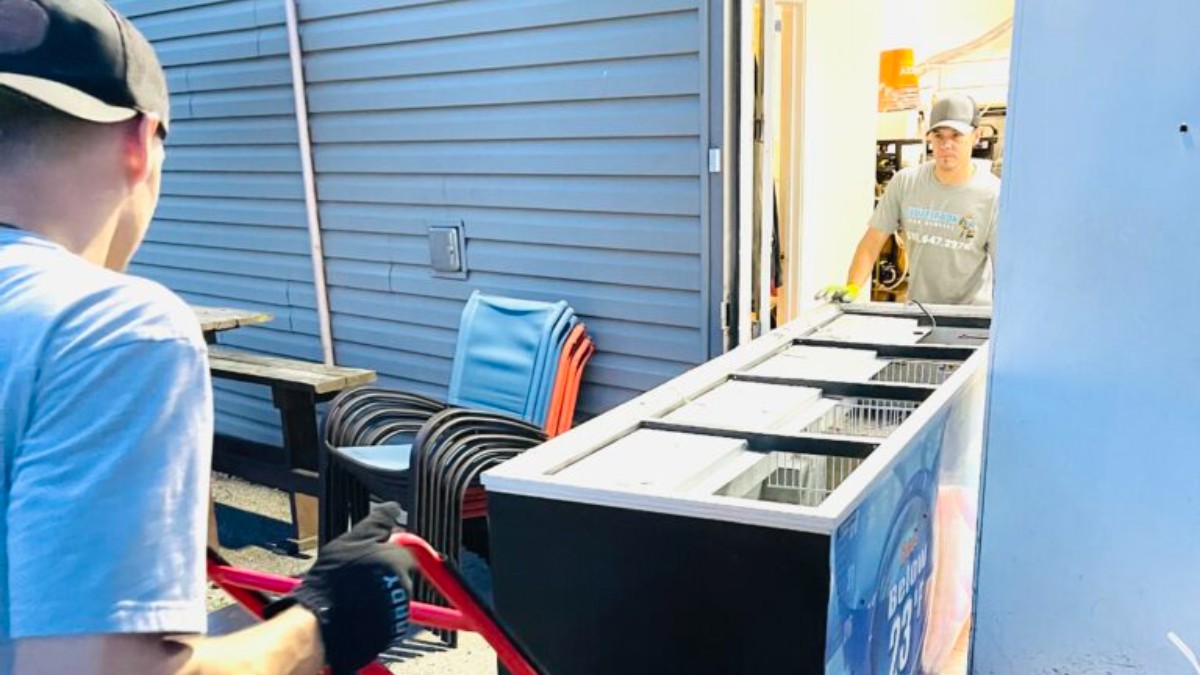
A refrigerator cannot be thrown away like ordinary bulk waste. Federal law requires the refrigerant to be recovered by a qualified party before final disposal, and requires documented proof that it happened. That single rule is why a fridge needs an appointment rather than a curb, and it shapes every disposal option available.
The good news is that refrigerators are one of the household items most likely to actually be recycled once they enter the right chain. The steel alone guarantees it. The task is getting the appliance into that chain correctly.
The rule that governs everything else
Refrigerators, freezers, window air conditioners, dehumidifiers and water coolers all contain refrigerant, and refrigerant is regulated under the Clean Air Act.
Under 40 CFR Part 82, Subpart F, the U.S. Environmental Protection Agency assigns responsibility to what it calls the final person in the disposal chain, who “is responsible for ensuring that refrigerant is recovered” before the appliance is finally disposed of.
That responsibility is documented, not assumed. The EPA requires the final disposer to hold one of two things: a signed statement from whoever recovered the refrigerant, giving their name, address and the date of recovery, or a contract with the supplier specifying that recovery will take place before delivery.
The agency is specific that an informal marker will not do. In its own words, EPA “does not mandate or accept a sticker as a form of verification.”
For a household, the practical translation is short. Whoever ends up handling the appliance last needs to be able to show the refrigerant was dealt with. That is why every legitimate disposal route for a fridge involves a scheduled handoff to someone equipped to do it, and why no legitimate route involves leaving it out unannounced.
Why this applies even to a fridge that does not work
A refrigerator that has stopped cooling usually still holds its refrigerant charge. A failed compressor, a broken thermostat or a door seal that gave up years ago do not release it. The EPA guidance addresses exactly this case, covering equipment that enters the waste stream with the charge intact.
An appliance that has been sitting in a garage for a decade is therefore treated the same as one taken out of a working kitchen last week.
What happens to a refrigerator that is disposed of properly
This is where appliances differ sharply from most other household items.
EPA figures for 2018 record 5.25 million tons of major appliances generated in a year, of which 3.14 million tons were recycled and 2.11 million tons went to landfill. That is a recycling rate close to sixty percent.
For comparison, the same EPA dataset records 12.1 million tons of furniture and furnishings generated in the same year, with 40,000 tons recycled. That is roughly a third of one percent.
The gap is about materials and markets. A refrigerator is largely steel, with copper in the compressor and aluminum in the condenser, and all three have a buyer. A sofa is a bonded assembly of wood, foam, springs and synthetic fabric that costs more to separate than the recovered material is worth.
So a refrigerator routed correctly has a genuinely good chance of coming back as steel. One left in a field does not, and takes its refrigerant with it.
The realistic disposal options
Retailer haul-away on delivery
The simplest route when a replacement is being delivered. Many appliance retailers will take the old unit at the same visit, sometimes included and sometimes for a fee.
Two things are worth confirming at the point of purchase rather than on delivery day: whether haul-away is actually included in the price quoted, and whether the crew will disconnect the appliance or expects to find it already disconnected and pulled clear. Water lines on ice makers are the usual sticking point, and a delivery crew that is not permitted to disconnect plumbing will leave the old unit where it stands.
Scrap metal recovery
Scrap yards do take appliances, but the refrigerant rule applies to them in exactly the way described above, which is why many will only accept a unit accompanied by documentation that the charge has been recovered, or will charge for doing the recovery themselves.
Call ahead and ask specifically what they require for a sealed-system appliance. Turning up without the answer is the most common wasted trip in this whole category. Where an appliance has already been stripped of its sealed system, it becomes an ordinary metal item, which is the same category as pallet and scrap metal removal.
Municipal or contracted bulk collection
Some communities in the region run a bulk item collection that includes appliances, usually with an advance booking and often with a separate charge for anything containing refrigerant. These rules are set by individual cities and townships rather than county-wide, and they change.
Confirm the current rule with your own city or township before putting an appliance out. An item left at a curb that does not meet the local rule generally stays at the curb.
Removal service
The route that fits when the appliance is in a basement, when there are stairs, when there is no replacement delivery to attach it to, or when the fridge is one item among several. Whole-space jobs such as a garage cleanout, a basement and attic cleanout or an estate cleanout almost always include at least one appliance, and it is more efficient to handle it inside that job than to schedule it separately. The residential junk removal overview covers how household jobs are scoped.
Commercial properties have the same rule and a different logistics problem, since break room refrigerators and under-counter units tend to come out during a lease handback alongside everything else. Those are usually scheduled as part of an office cleanout or a wider commercial junk removal job.
Whichever service is used, say at the point of booking that the item contains refrigerant. It is a scheduled item, and flagging it is what keeps a job to one visit. The appliance removal page covers what that side of the work involves.
Preparing the appliance before it is collected
A few steps make the difference between a ten-minute removal and a problem.
- Empty it completely, including the freezer and the door shelves. A full refrigerator is significantly heavier and can leak during the carry.
- Defrost it in advance if there is ice buildup. Melting ice during transport is the most common cause of water damage on an appliance removal.
- Disconnect the water line to the ice maker or dispenser, and shut off the supply valve. This is plumbing, not appliance work, and many crews are not permitted to do it.
- Unplug it and move the cord so it cannot catch on a stair nosing.
- Remove or secure the doors according to the instruction given when booking. Do not remove doors on an appliance that will be sitting accessible to children before collection.
- Clear the route. A refrigerator needs a corridor roughly three feet wide, and door frames, stair turns and storm doors are the usual obstacles.
- Measure the doorway if the appliance was installed before a renovation. Kitchens get remodeled around appliances more often than people remember.
The guide to preparing for a junk removal appointment covers the rest of the access and parking questions that apply to any large item.
What not to do
Do not attempt to release refrigerant, cut a line, or puncture the sealed system. Venting refrigerant is prohibited, and the sealed system is under pressure.
Do not leave a refrigerator with its doors attached and latched in a location a child can reach.
The other items that usually surface at the same time
Clearing an appliance rarely happens in isolation. The categories that tend to come out of the same basement or garage have their own routes, and Butler County residents have free ones.
The Butler County Recycling and Solid Waste District runs a household hazardous waste drop-off every Thursday from 2 p.m. to 7 p.m., and a computer, television and battery recycling drop-off every Friday from 9 a.m. to 1 p.m., along with scheduled tire recycling events during the year. The district describes these as a way for residents to manage hard-to-dispose items “without any Fees.”
Confirm the current schedule with the district before making the trip, since times and eligibility change.
Ohio law reinforces why these categories are separate. Ohio Administrative Code rule 3745-555-650, effective July 15, 2024, prohibits a solid waste transfer facility from accepting hazardous waste, asbestos-containing material, PCB waste, untreated infectious waste, liquids that can readily be released, scrap tires outside a designated scrap tire route, lead-acid batteries outside a resident-to-recycling route, and dedicated loads of source-separated yard waste unless bound for composting.
Those materials are not a matter of preference for any hauler. They have a legally separate destination. Renovation waste follows its own route again, which is why construction debris removal is handled as a separate category from household pickups, and a kitchen strip-out that removes cabinetry along with the appliances falls under interior demolition.
How Butler County compares
Ohio EPA publishes annual figures for each solid waste management district. In 2023 the Butler County district reported 548,301 tons of residential and commercial waste generated across a population of 393,043, of which 72,950 tons were recycled and 475,351 tons disposed. That is a recycling rate of 13.30 percent, against a statewide residential and commercial rate of 29.54 percent.
Appliances are one of the categories where an individual household decision moves that number, because a refrigerator handled correctly is close to sixty percent recoverable by weight and one handled carelessly is not recovered at all.
Common questions
Can I put a refrigerator out with the trash?
No. Federal rules under 40 CFR Part 82 require refrigerant to be recovered before final disposal, with documentation that it happened, so a refrigerator needs a scheduled route rather than a curb. Some communities run a bulk collection that accepts appliances by advance booking, usually with a separate charge for refrigerant handling. Check your own city or township.
Does the rule still apply if the fridge is broken?
Yes. A refrigerator that has stopped cooling normally still holds its refrigerant charge. A failed compressor or thermostat does not release it, and EPA guidance covers equipment entering the waste stream with the charge intact.
Who removes the refrigerant?
Someone equipped to do it, using recovery equipment meeting EPA performance standards. The obligation sits with the final person in the disposal chain, who must hold either a signed statement naming whoever recovered the refrigerant with the date, or a contract specifying recovery before delivery.
Can I take a refrigerator to a scrap yard?
Many scrap yards accept appliances, but because the refrigerant rule applies to them too, they typically either require documentation that the charge was recovered or charge to handle it. Call and ask what they require for a sealed-system appliance before loading it.
Is an old refrigerator worth any money as scrap?
The steel, copper and aluminum have recovery value, but for a single household unit that value rarely covers the labor and the refrigerant handling attached to it. Appliances are recycled at a high rate because the materials are worth recovering at industrial scale, not because an individual fridge is worth much.
What do I need to do before collection?
Empty it, defrost it if there is ice, disconnect and shut off any water line, unplug it, clear a three-foot path, and measure the doorway if the kitchen has been remodeled since the appliance went in.
Do the same rules cover freezers and air conditioners?
Yes. Freezers, window air conditioning units, dehumidifiers and water coolers all contain refrigerant and fall under the same requirements as a refrigerator.
Appliance removal in West Chester and Butler County
At Clutter Box Junk Removal, appliances are a scheduled item, so tell us when you book that there is a refrigerator, freezer or air conditioner in the job and we will arrive set up for it. Basements and stairs are not a problem, they are just worth knowing about in advance.
We work across West Chester Township and Butler County, including Mason, Liberty Township, Fairfield and Hamilton. See what appliance removal covers, or get in touch to book a pickup. If the appliance is one part of clearing a whole space, start with cleanouts instead, and the process page covers how a visit runs.
Sources
- U.S. Environmental Protection Agency, Stationary Refrigeration Safe Disposal Requirements, 40 CFR Part 82 Subpart F
- U.S. Environmental Protection Agency, Durable Goods: Product-Specific Data
- Ohio EPA, Annual District Reports: Disposal, Recycling and Generation Analytic
- Ohio Administrative Code Rule 3745-555-650, Waste handling, effective July 15, 2024
- Butler County Recycling and Solid Waste District, special collection programs